|
Key takeaways • A sinking fund is money you save in small amounts for a cost you know is coming. • The math is simple: cost ÷ months until it is due = what to save each month. • Paid every two weeks? Divide the yearly cost by 26 to get a per-paycheck amount. • Give each fund its own savings goal so you can see it grow and never spend it by mistake. |
Some bills don't show up every month: your car registration, holiday gifts, or that yearly app subscription that renews in March.
They are easy to forget because they are rare. Then they land all at once and eat your grocery money. A sinking fund fixes that.
What is a sinking fund?
A sinking fund is money you set aside, a little at a time, for one specific cost you know is coming. When the bill arrives, you pay it from the fund. Your normal budget doesn't feel it.
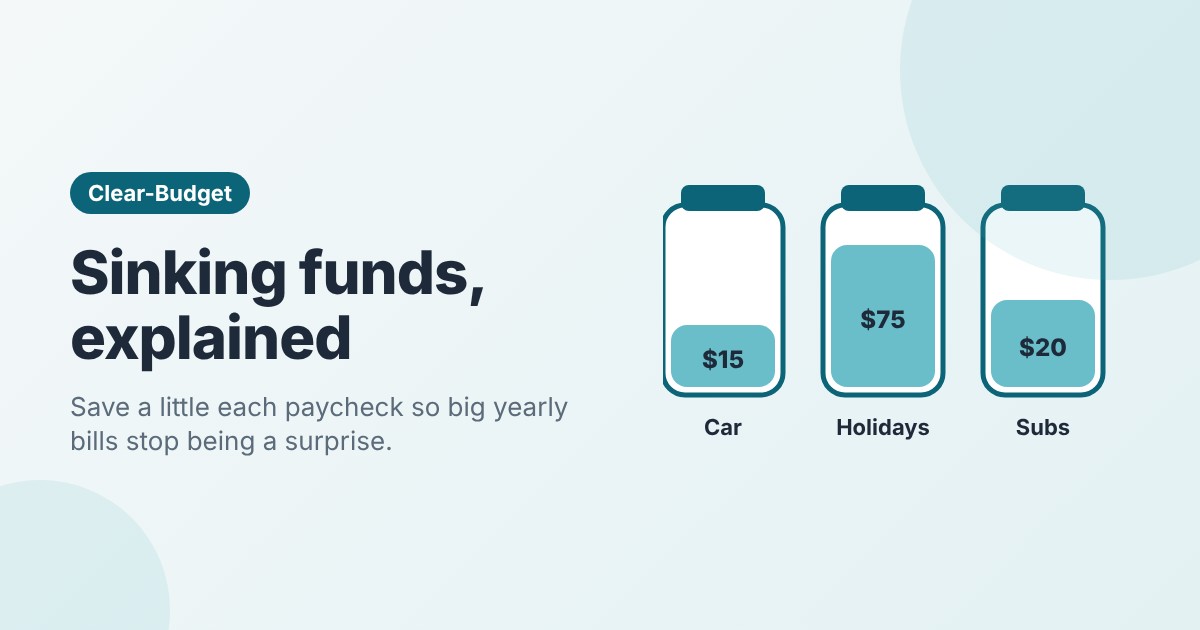
Think of it as paying for the bill in small pieces ahead of time. Instead of $180 in one hit, you save $15 a month for a year.
Sinking fund vs emergency fund
They sound alike, but they do different jobs. An emergency fund is for things you can't predict, like a job loss or a surprise medical bill. A sinking fund is for things you can predict, even if they only happen once a year.
Keeping them apart matters. If you pay for holiday gifts out of your emergency fund, it won't be there when a real emergency hits. Our emergency fund guide covers how big that one should be.
What costs need a sinking fund?
Go through last year's bank statements and look for anything that didn't happen every month. Common ones include:
• Car registration, inspection and license renewals
• Car maintenance: oil changes, tires, brakes
• Holiday and birthday gifts
• Annual subscriptions and memberships
• Insurance you pay every 6 or 12 months
• Back-to-school costs, sports fees and camps
• Vacations and travel
• Pet care like yearly vet visits
These are a type of variable or irregular expense. If you want a refresher on how they differ from fixed bills, see fixed vs variable expenses explained.
How to calculate a sinking fund
You only need two numbers: how much the cost will be, and how long until it is due.
|
The formula: amount needed ÷ months until due = amount to save each month. If you are paid every two weeks and the cost is a full year away, divide the yearly cost by 26 to get a per-paycheck amount. |
If you don't know the exact cost, use last year's number and round up a little. It is better to have a few dollars left over than to come up short.
A worked example: Jordan's sinking funds
Jordan is paid every two weeks, so 26 paychecks a year. Looking back at last year, Jordan finds four costs that keep catching him off guard.
|
Fund |
Yearly cost |
Per month (÷ 12) |
Per paycheck (÷ 26) |
|
Car registration |
$180 |
$15.00 |
$6.92 |
|
Holiday gifts |
$900 |
$75.00 |
$34.62 |
|
Annual subscriptions |
$240 |
$20.00 |
$9.23 |
|
Car maintenance |
$600 |
$50.00 |
$23.08 |
|
Total |
$1,920 |
$160.00 |
$73.85 |
So Jordan moves $73.85 out of every paycheck into his sinking funds. That feels a lot smaller than finding $900 in December or $180 when the registration notice arrives.

Jordan's four funds add up to $160 a month, or $73.85 per biweekly paycheck.
What if the bill is coming sooner?
The simple ÷ 12 math only works if you have a full year. If you start late, use the real number of months left.
Say Jordan starts his holiday fund in April, with 8 months to go until December. He needs $900 ÷ 8 = $112.50 a month this year. Next year, starting in January, it drops back to $75.
If that catch-up amount is too much, lower the goal for this year. Spending $700 on gifts with cash is better than spending $900 on a credit card.
How to set up sinking funds as savings goals
A sinking fund only works if the money stays put. The easiest way to protect it is to give each one a name and a target.
1. List your costs. Write down each irregular expense, how much it is, and when it is due.
2. Work out the amounts. Use the formula above for each one.
3. Add them to your budget as expenses. Treat each transfer like a bill, dated on payday.
4. Pick where the money lives. Many people use one separate savings account and track each fund inside it. You don't need a separate bank account for every goal.
5. Track each fund's balance. This is the step most people skip, and it is the one that keeps the money from blending together.
Using savings goal buckets in Clear-Budget
In Clear-Budget, each sinking fund can be its own savings goal bucket. You give it a name and a target, like "Car registration, $180." The bucket shows how much you have saved and when you will reach the goal at your current pace.

A savings goal bucket in the Clear-Budget phone app, showing progress and the date you will reach the goal.
Then add the transfer to your budget as an item on each payday and link it to the bucket. When you mark it paid, the bucket goes up. You can set it to repeat every two weeks or monthly, so you only set it up once.
Because Clear-Budget never asks for your bank login, you stay in control. You decide what moves where, and the app keeps the score.
Tips to make sinking funds work
• Start with one or two. Pick the cost that hurt most last year. Add more funds later.
• Round up. Save $7 instead of $6.92. The extra builds a small cushion.
• Don't raid one fund for another. If the car fund is short, that is a sign to adjust next year's amount.
• Review once a year. Prices change. Update each target when the real bill comes in.
• Spend it without guilt. The money was saved for this. Using it is the plan working.
Sinking funds pair well with almost any method, from the 50/30/20 rule to zero-based budgeting. In both, a sinking fund is just one more line with a job.
Common sinking fund mistakes
Most problems come from setting the funds up once and then not checking on them. Watch out for these:
• Forgetting a cost entirely. Look at a full 12 months of statements, not just the last one or two.
• Mixing the money with spending cash. If it sits in checking, it tends to disappear. Keep it in savings.
• Setting amounts you can't keep up. A smaller amount you save every paycheck beats a big one you skip.
Missing irregular costs is one of the classic budgeting mistakes to avoid. Sinking funds are the cure.
Sinking funds and a tight budget
If money is already tight, $73 a paycheck might sound impossible. Start smaller. Even $10 a paycheck toward the holidays is $260 by the end of the year.
You can also shrink the cost itself. A smaller gift list, a cheaper subscription plan, or doing a simple car job yourself all lower the target.
Start your first sinking fund today
Pick one cost that is coming in the next year. Divide it by the months you have left. That is your number.
If you want an easy place to track it, create a free Clear-Budget account. Add a savings goal bucket, set up the transfer on payday, and watch the balance grow. If you are paid every two weeks, our guide to budgeting by paycheck shows how to fit it into each check.
Frequently asked questions
How many sinking funds should I have?
There is no set number. Start with the one or two costs that cause the most stress, then add more as you go. You can always add more once the first ones are running.
Where should I keep sinking fund money?
A separate savings account works well. It is out of sight from daily spending but easy to reach. You can keep several funds in one account and track each one as its own goal.
Is a sinking fund the same as an emergency fund?
No. A sinking fund is for costs you know are coming, like car registration. An emergency fund is for surprises you can't plan, like a job loss.
What if I need the money early?
Use it if you truly must, then restart the fund. Next time, check whether the target or timing needs changing so it doesn't happen again.
This article is for general education and is not financial advice. Your situation may be different, so adjust the numbers to fit your own budget.