|
Key takeaways • Your bank balance is not what you can spend. Some of it is already spoken for. • Safe to spend = balance − pending charges − bills due before payday − savings set aside. • Divide by the days until payday to get a simple daily limit. • Watch for yearly bills, pending charges and autopays you forgot about. |
You check your bank app and see $980. It feels like plenty. Then rent, the phone bill and insurance come out, and suddenly it isn't.
The number in your bank app shows what you have. It doesn't show what you can spend. The difference is your bills and savings, and that is what this guide helps you work out.
What "safe to spend" means
Your safe-to-spend number is the money you can use for everyday things until your next paycheck, without coming up short on a bill.
|
The formula: safe to spend = current balance − pending charges − bills due before your next paycheck − money you plan to save before payday. |
What is left covers groceries, gas, eating out and anything else that is flexible. If you stay inside it, every bill is covered and your savings still happen.
Step-by-step example: Taylor
Taylor is paid every two weeks. Today is Wednesday, October 14.
The next paycheck lands on Friday, October 23. That is 9 days away.
Step 1: Start with the real balance
Taylor's checking account shows $980. That is the starting point.
Step 2: Subtract pending charges
Taylor bought gas yesterday for $42. It shows as "pending" and hasn't come out of the balance yet. It will.
$980 − $42 = $938.
Step 3: Subtract bills due before payday
Next, Taylor lists every bill due between today and October 23.

Four bills land before the next paycheck, for a total of $299.
|
Bill |
Due date |
Amount |
|
Phone |
Oct 16 |
$55 |
|
Car insurance |
Oct 20 |
$128 |
|
Streaming service |
Oct 21 |
$16 |
|
Credit card payment |
Oct 22 |
$100 |
|
Total |
|
$299 |
$938 − $299 = $639.
Rent isn't on the list because it is due on the 1st, after this paycheck. It belongs to the next one.
Step 4: Subtract savings you plan to set aside
Taylor saves $100 per paycheck for an emergency fund and $40 for a car registration sinking fund. Those transfers haven't happened yet this period, so they come out too.
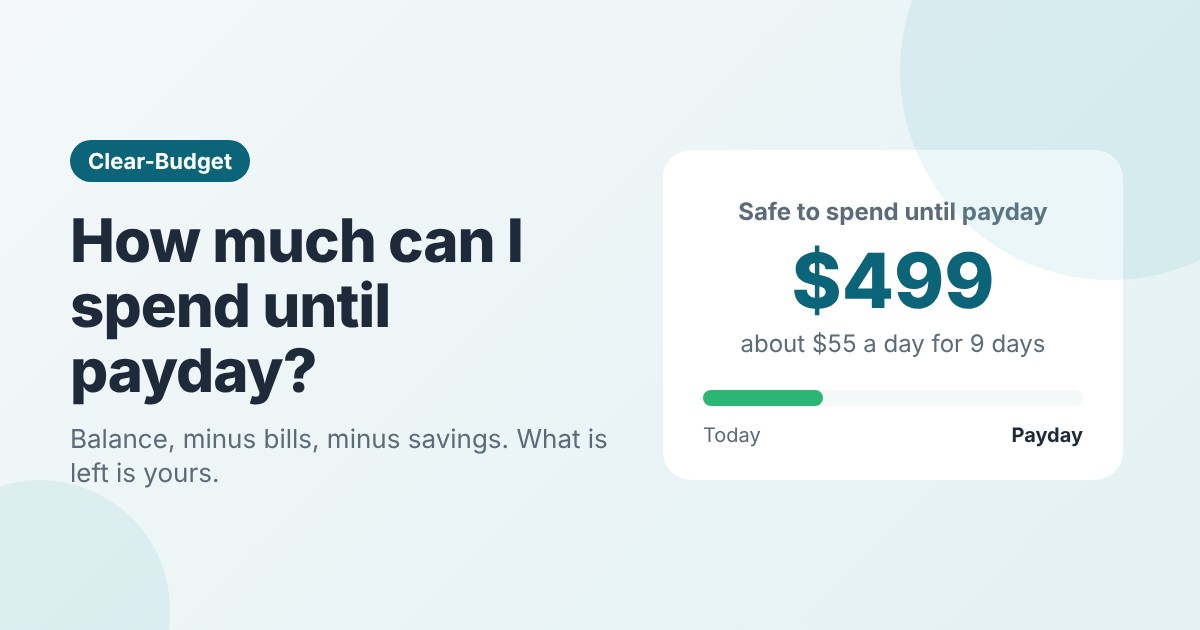
$639 − $140 = $499.
Step 5: Turn it into a daily number
Taylor has $499 to spend over 9 days. $499 ÷ 9 = about $55 a day for groceries, gas and fun.

Taylor's $980 balance becomes $499 safe to spend once bills and savings come out.
A daily number is easier to use than a total. If Taylor spends $30 today, there is a little more room tomorrow. If Taylor spends $90 on a dinner out, the next couple of days need to be lighter.
The traps that throw off the number
The math is simple. The hard part is not missing anything. Here are the most common mistakes.
Forgetting annual and irregular bills
A yearly subscription renewal or a six-month insurance bill can be due this week and you won't remember it. Keep every bill on one list with its date, including the rare ones.
Ignoring pending charges
Card purchases can take a few days to post. Gas stations and restaurants sometimes hold a different amount at first. Always look at the pending list and subtract it.
Forgetting autopays and small subscriptions
Streaming, apps and memberships are small, but they add up. Look at last month's statement to catch them all.
Counting money that isn't yours yet
A refund you are waiting for, or money a friend owes you, isn't safe to spend until it arrives.
Skipping savings
If you only save "what is left," there is rarely anything left. Take savings out first, as part of the math.
These traps show up in our list of common budgeting mistakes too. A good habit is to track your spending for a few weeks so you know what normally comes out.
What if the number is negative?
If your safe-to-spend number comes out below zero, you have spotted a problem early. That is a good thing. You still have time to act.
• Pause savings for one paycheck. Better than an overdraft.
• Ask to move a due date to after payday. Our guide on never missing a bill covers how.
• Cut flexible spending to the bare minimum until payday.
• Look at the bigger picture. If this happens every period, your budget needs a reset.
If your income changes from week to week
The formula works the same way if you are paid in tips or by the gig. The tricky part is that you don't always know when the next "payday" is.
In that case, pick a set date, like the 1st and the 15th, and treat it as payday. Count only the money you already have, never the money you expect. Our guide on budgeting with irregular income explains how to pay yourself a steady amount so this math gets easier.
A quick safe-to-spend checklist
Run through this list any time you are about to make a bigger purchase:
1. What is my real balance right now?
2. What is pending that hasn't posted yet?
3. Which bills are due before my next paycheck, including autopays?
4. Is any yearly or six-month bill due in this window?
5. How much am I planning to save before payday?
6. How many days until payday, and what does that work out to per day?
If the purchase still fits after all six, go ahead and enjoy it. That is the point of a budget: spending without the worry.
Make it a habit
You don't need to do this math every day. Twice per pay period is enough: once on payday, and once halfway through.
The easiest way is to plan your budget by paycheck instead of by month. Then each budget runs from one payday to the next, and the "until payday" part is built in. See how to budget by paycheck for a full walkthrough.
Tools that do the math for you
Our free paycheck budget calculator helps you see how a paycheck splits across bills, savings and spending. It is a quick way to check your numbers.
In Clear-Budget, you can create a budget that runs from today until your next paycheck. Add your bills with their due dates and your savings transfers. The running balance shows what is left after each one, so the last line shows roughly what is safe to spend.
A dedicated safe-to-spend-until-payday number is coming soon to Clear-Budget, so you won't need to do the math yourself. Until then, the running balance gets you most of the way.
Sign up free with Google or email. No bank login needed.
Frequently asked questions
How often should I check my safe-to-spend number?
Twice per pay period is enough for most people: once on payday and once halfway through. Check again before any bigger purchase.
How do I calculate how much I can spend until payday?
Take your balance, subtract pending charges, subtract bills due before your next paycheck, and subtract any savings you plan to set aside. What is left is safe to spend.
Should I include groceries in my bills?
Usually no. Groceries and gas come out of your safe-to-spend money. If you want to protect a set grocery amount, subtract it as if it were a bill.
What if a bill is due on payday?
If the paycheck reliably lands before the bill is taken, the next paycheck can cover it. If you are not sure, count it in this period to be safe.
Does Clear-Budget show a safe-to-spend number?
A safe-to-spend-until-payday number is coming soon. Today, you can make a budget that runs until your next paycheck and use the running balance.
This article is for general education and is not financial advice. Your situation may be different, so adjust the numbers to fit your own budget.