Creating your first budget might sound intimidating. It is actually one of the simplest ways to take control of your money.
A budget is not about restriction. It is about making your money work for you, and if you have ever wondered where your paycheck went, this guide will help you build a clear plan.
This is the hands-on guide: five steps, one worked example, and a sample budget you can copy. If the idea of budgeting is new to you, start with what budgeting is and why it matters.
|
Key takeaways • Start with take-home pay, then list fixed bills, then estimate variable spending from real statements. • Add savings as if it were a bill you pay yourself. • If expenses are higher than income, trim and adjust until the plan balances. • Plan to tweak the budget weekly in your first month. It is supposed to change. |
Before you start: gather three things
Set aside about an hour. You will need:
• Your last two or three pay stubs, or your bank deposits
• Your last two or three months of bank and credit card statements
• A list of your bills and their due dates
Paper, a spreadsheet or a budgeting app all work. Pick whatever you will actually open again next week.
Throughout this guide we will follow Dana, who is paid $1,850 every two weeks and is making her first budget.
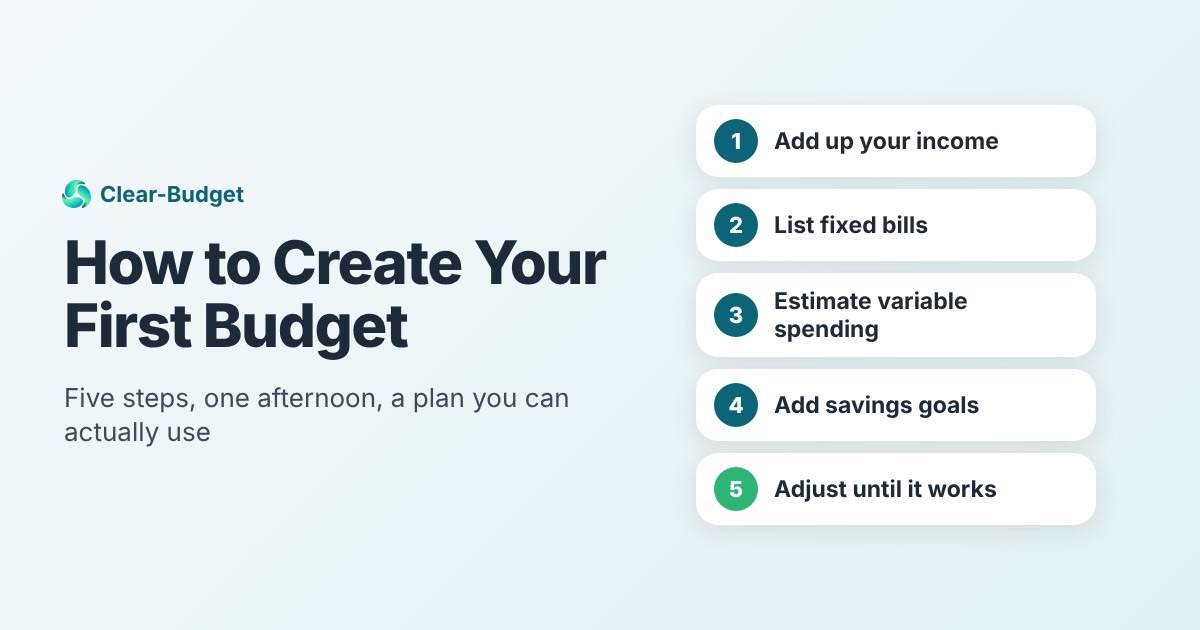
Step 1: Calculate your monthly income
Start with your take-home pay, the amount that lands in your account after taxes. Include:
• Salary or paychecks
• Side hustle income
• Freelance work
• Any other regular income
If your income varies, use a conservative average. Take your lowest normal month rather than your best one.
Dana's numbers: two paychecks of $1,850 a month, so $3,700. Being paid every two weeks means two months a year have a third paycheck; Dana leaves those out of the monthly plan on purpose. Here is more on how to budget a biweekly paycheck.
Step 2: List your fixed expenses
Fixed expenses are bills that usually stay the same each month:
• Rent or mortgage
• Car payment
• Insurance
• Phone and internet
• Subscriptions
These form your financial baseline. Write each one down with its amount and due date. Not sure which bills count as fixed? See fixed vs variable expenses.
Dana's numbers: rent $1,250, car payment $280, utilities $140, car insurance $120, phone and internet $110, credit card minimum $60 and subscriptions $30. That is $1,990.
Step 3: Estimate your variable spending
Variable expenses change from month to month:
• Groceries
• Gas
• Eating out
• Shopping
• Entertainment
Do not guess these. Look at your past bank statements, add up each category for two or three months, and divide by the number of months.
Dana's numbers: groceries averaged $450, gas $160 and household and personal items $90. Eating out averaged $300 and fun spending $150, so those went in at those amounts for now.
Step 4: Add savings goals
Treat savings like a bill you pay yourself. Common goals include:
• Vacation
• Car repairs
• Holidays
Even small amounts build strong habits. A $40 monthly car repairs fund means the next $400 repair is mostly covered.
Dana's numbers: emergency fund $250, car repairs $40 and holidays $40. She also wants to pay $250 extra on her credit card and keep a $150 buffer for surprises.
Step 5: Adjust until it works
Now add everything up and subtract it from your income. If expenses are higher than income:
• Trim non-essentials first
• Reduce impulse spending
• Adjust categories so they are realistic, not wishful
If you have money left over, give it a job, such as savings or extra debt payments. A good budget is realistic, not perfect.
Dana's numbers: her first draft came to $3,870, which is $170 more than she earns. She cut eating out from $300 to $180 and fun money from $150 to $100. Now it balances exactly.
Dana's finished budget

|
Item |
Type |
Monthly amount |
|
Income (2 × $1,850) |
|
$3,700 |
|
Rent |
Fixed |
$1,250 |
|
Car payment |
Fixed |
$280 |
|
Utilities |
Fixed |
$140 |
|
Car insurance |
Fixed |
$120 |
|
Phone and internet |
Fixed |
$110 |
|
Credit card minimum |
Fixed |
$60 |
|
Subscriptions |
Fixed |
$30 |
|
Groceries |
Variable |
$450 |
|
Eating out |
Variable |
$180 |
|
Gas |
Variable |
$160 |
|
Fun money |
Variable |
$100 |
|
Household and personal |
Variable |
$90 |
|
Emergency fund |
Savings |
$250 |
|
Car repairs fund |
Savings |
$40 |
|
Holidays fund |
Savings |
$40 |
|
Extra credit card payment |
Debt |
$250 |
|
Buffer for surprises |
Buffer |
$150 |
|
Left unplanned |
|
$0 |
A sample first budget you can copy and change to your own numbers.
Copy this layout and swap in your own numbers. Your categories may differ, and that is fine.
Your first month: how to use the budget
A budget only works if you look at it. In your first month, try this simple rhythm:
1. On payday, move your savings first, then mark off bills as you pay them.
2. Once a week, spend 10 minutes comparing what you spent with what you planned.
3. When a category runs over, move money from another category instead of giving up.
4. At the end of the month, update any numbers that were wrong and set up next month.
Tracking your spending during the month is what turns a plan into a habit. By month three, most people find their numbers are close to right.
When to change your budget
Your first budget is a draft. Expect to change it, especially in the first three months.
Update it whenever one of these happens:
• Your pay changes, up or down
• A bill goes up, such as rent or insurance at renewal
• A category runs over two months in a row, which means the number was too low
• You pay off a debt and free up its payment
• You reach a savings goal and need a new one
When a debt is paid off, move its payment straight to the next goal. Dana plans to send her $250 extra card payment to her emergency fund once the card is clear.
If your income changes from month to month, budget on your lowest normal month. In a better month, send the extra to savings or debt first.
Common beginner mistakes
Watch out for these four as you start:
• Being too strict. Leave room for some fun, or the budget will not last.
• Forgetting irregular expenses, such as car repairs or yearly subscriptions.
• Not tracking spending, so the budget slowly drifts away from reality.
• Giving up after one bad month. Adjust and try again.
Progress beats perfection. We cover these and more in 10 common budgeting mistakes to avoid.
How budgeting apps help
You can budget on paper, but an app makes several parts easier:
• Tracking spending
• Managing categories
• Seeing your progress
• Planning ahead
They remove the guesswork and save time each week.
Clear-Budget is free and built for exactly this. You add each paycheck and bill with its due date, set repeating ones to fill in weekly, every two weeks or monthly, and see a running balance after each item. A guided tour walks you through a practice budget first, and it never asks for your bank login. Create your first budget free.
Paid every two weeks? The free paycheck budget calculator splits one paycheck across the bills due before the next one.
Quick takeaway
Your first budget does not need to be perfect. It just needs to exist.
Start simple, adjust often and build confidence over time.
Frequently asked questions
How long does it take to create a first budget?
About an hour if you have your pay stubs and recent statements ready. After that, weekly check-ins take about 10 minutes.
What if my expenses are more than my income?
Trim non-essential spending first, then look at bigger costs over time. Make the plan balance on paper before the month starts.
Should I budget by month or by paycheck?
Either works. If you are paid every two weeks and bills feel tight before payday, planning one paycheck at a time can be easier.
How much should I save in my first budget?
Any amount you can keep up. Even $10 to $25 per paycheck builds the habit, and you can raise it later.
What do I do with a third paycheck?
If you are paid every two weeks, two months a year have three paychecks. Many people send that extra check to savings or debt.
This article is for general education and is not financial advice. Consider your own situation or talk to a qualified professional before making financial decisions.